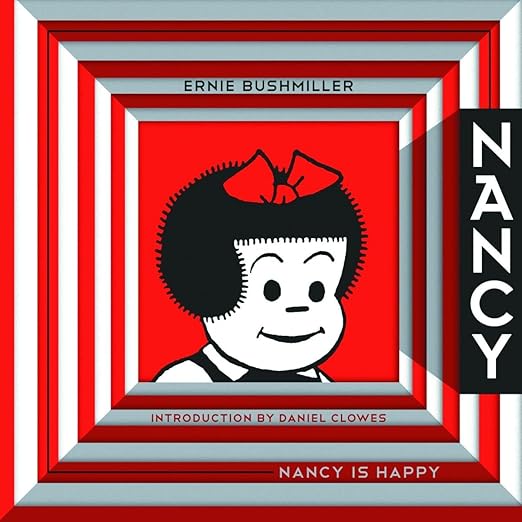
Friday, July 11, 2025
Ernie Bushmiller, Nancy (1938)
Thursday, March 21, 2024
Osamu Tezuka, The Mysterious Underground Men (1948)
The Mysterious Underground Men by Osamu Tezuka (1948)
Tezuka's first longform "story manga" is a charming children's science fiction tale of a boy inventor and an anthropomorphic rabbit on a quest to tunnel through the earth in their rocket train. Equal parts Jules Verne, Tom Swift, and Floyd Gottfredson, the feverish plot revolves around an apocalyptic war with the titular subterranean civilization. The common Tezuka theme of what it means to be human is embodied in the highly capable Mimio, the rabbit character given intelligence by a cadre of Frankenstein-esque scientists, who must prove his worth by saving his friends and humanity. In his Pinocchio-like agonizing, Mimio anticipates later heroes in the Tezuka pantheon like Astroboy.
The critics:
Initially published in 1948, The Mysterious Underground Men is a lot of things: a straightforward adventure story, a funny-animal book, a demonstration that manga can incorporate serious drama, and, paradoxically, a fun read. The hero’s name is Young John, and the introductory pages describe him as “a science whiz kid [who] invents a rocket train and conquers the center of the earth after fighting monsters and criminals.” His sidekicks are Uncle Bill and Mimio. The latter is a humanoid rabbit whose creation stands as one of the most interesting and visually-striking sections of the book. Early in the story, Mimio’s animal nature is forced out of him through surgery and electrification, which combine to domesticate and civilize him. The progression is violent, odd, and rather Disneyfied in its execution.
On that note, some consider Tezuka the Walt Disney of Japan for his influence on pop culture there, and the imagination on view here is prodigious. Our heroes fight both a villainous group of men led by a gentleman named Ham-Egg and a legion of termite soldiers commanded by their queen. The termites aim to take back the surface after being forced underground, and their method for retribution is straight-up terrorism, with bombs setting cities afire and toppling skyscrapers. One wonders how this imagery was received at the time, a mere three years after the atomic bombing of Hiroshima and Nagasaki, not to mention the firebombing of Tokyo and other major cities. Regardless of the intent, it adds a darker edge to what appears to be a children’s book.
Saturday, March 16, 2024
Work in Progress: 1963
Thursday, January 19, 2023
Aline Kominsky-Crumb, The Bunch's Power Pak Comics #1 (1979)
The Bunch's Power Pak Comics #1, by Aline Kominsky-Crumb (1979).
Revelatory, ground-breaking autobiographical collection of comics stories. Aline Kominksy's confessional, scrawly cartooning is made up of a great variety of agonized linework, full of contrasting hatching and stippling give a sense of real texture to her drawings. All her figures are awkwardly posed, stuffed into ill-fitting clothing, with huge noses, blubbery lips. And what these figures do and say! Oh my! The stories here chronicle Aline's early life and upbringing and depict taboo subjects like her parents having sex, Aline sitting on the toilet, her love-hate relationship with her mother ("Blabette") and Aline confessing all her most non-flattering, innermost desires and vanities, all in abject, brain-searing detail that influenced a generation of comics makers.
The critics: "Aline depicts this all with a critical eye, sometimes commenting directly even when she doesn’t need to (e.g. , a panel showing the Bunch receiving money for her report card is accompanied by a narrative tag labeling the moment her “first training in capitalist greed and opportunism”) . The approach creates a tension between Kominsky’s need to grow out of those elements of her upbringing that are offensive to her and the self-obsession implicit in her continuing autobiographical drive."
--Bill Sherman, “Underground Comix: Memories and Studebakers” (The Comics Journal #55, 1980).
Saturday, September 3, 2022
Chester Brown, Yummy Fur (1986)
One of the greatest comic book series of all time, Chester Brown's surrealistic, scatalogical, sacred-and-profane Yummy Fur debuted as a self-published mini-comic before being picked up by Toronto's Vortex Comics (the seven issues of the mini-comic were reprinted in the first 3 issues of the Vortex series). It was in the pages of Yummy Fur that Brown first serialized his Ed the Happy Clown graphic novel and where he debuted his groundbreaking, revelatory autobiographical pieces, some of which were collected in The Playboy and I Never Liked You. Yummy Fur was also the home for Brown's quirky, personal, unvarnished Gospel adaptations.
The critics: "It’s hard to remember this now, but when Chester first started cartooning he did seem to be a late-born underground cartoonist, someone whose roots were clearly in the comics of Crumb and Justin Green. In chronological terms, Chester’s earliest work is much closer to the heyday of the undergrounds (say 1968-1974) than we are to Chester’s first published work. The sexual radicalism of Chester’s art, his enjoyment at shocking his audience, and his direct political engagement all place him still in the underground comics tradition." --Jeet Heer, "A Chester Brown Notebook" (The Comics Journal, May 19, 2011).
Saturday, August 27, 2022
Thursday, August 11, 2022
-
Nancy by Ernie Bushmiller (1938) Ernie Bushmiller took over Larry Whittington's "Fritzi Ritz" comic strip in 1925 and intro...
-
The Mysterious Underground Men by Osamu Tezuka (1948) Tezuka's first longform "story manga" is a charming children's sc...
-
Work in progress: I think this is almost the full slate of 1963's best comics, give or take a few tweaks. I'm not sure exactly how I...


